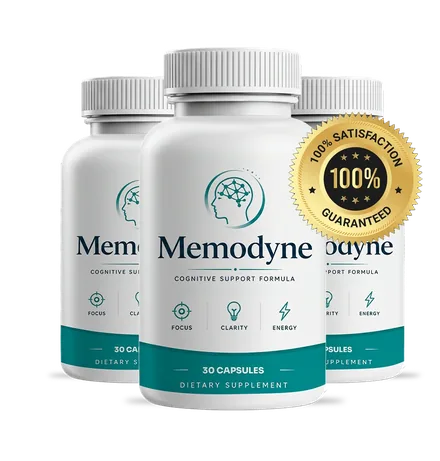
Memodyne Official Website: A Once-Daily Cognitive Support Capsule with Niacin and L-Citrulline
Sold by Memoadyne, the U.S. stocking partner for Memodyne, from New York. Order desk +1 (302) 200-3480.
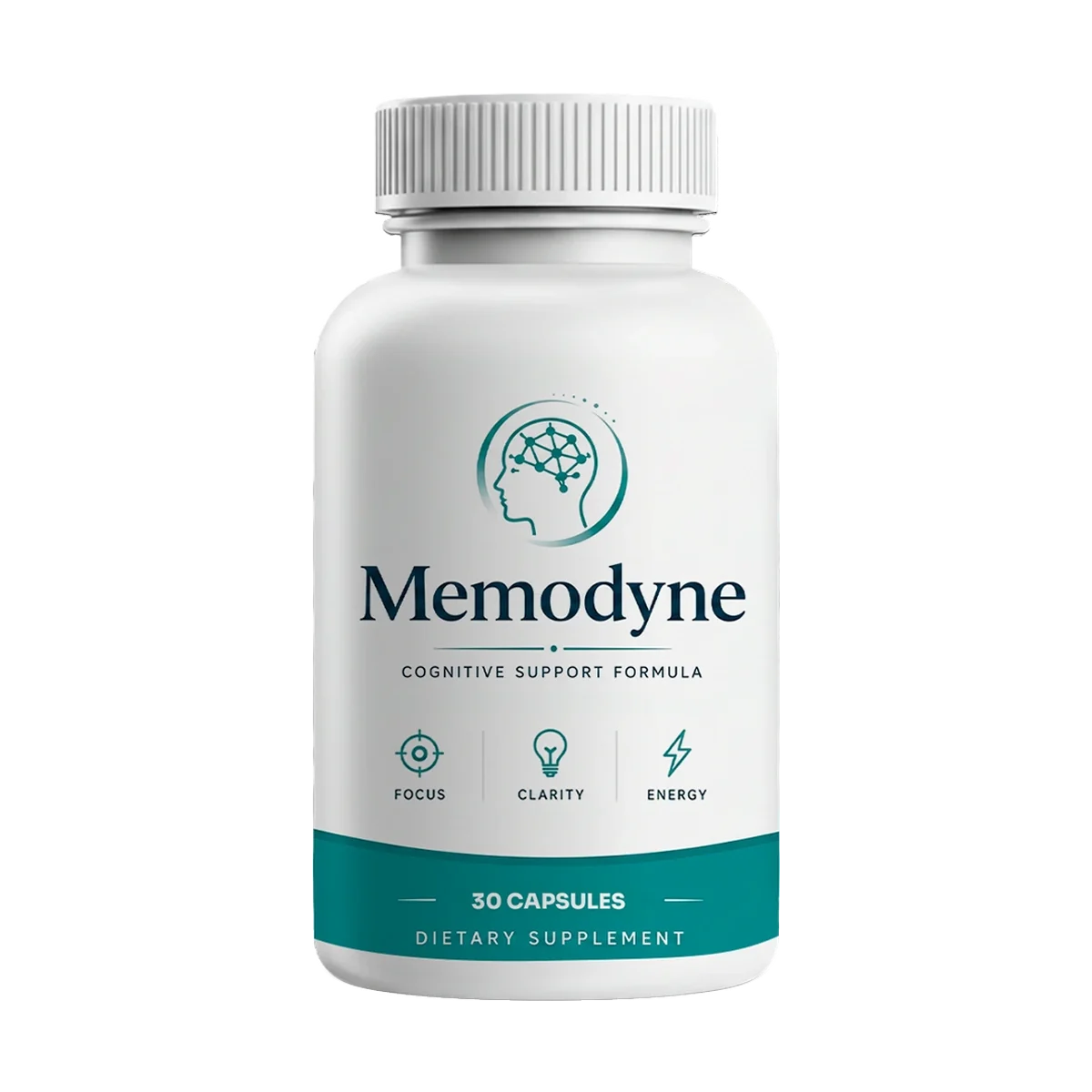
Lot MEM-26/ME-4386 · focus, clarity, energy
- 1 capsule a day, before a meal
- 30 capsules a bottle, so a bottle is a month
- 7 ingredients on the panel, each with its amount
- 60 days from purchase to change your mind
- 2, 3 or 6 bottles to a pack, and no single bottle
Memodyne is a once-a-day capsule sold for memory and focus. A bottle holds 30 capsules, a month at one a day before a meal. Its Supplement Facts panel prints an amount for all 7 ingredients: 400 mg of arginine and 200 mg of citrulline in two forms each, 40 mg of beta-alanine, 18 mg of calcium and 7.5 mg of niacin. Packs run two, three or six bottles behind a 60-day window.
Below: the seven amounts on the panel and the research each one comes out of, how far those amounts sit from the ones the trials used, how long buyers say they waited, how the three packs differ, what the 60 days actually cover, and the two questions worth asking before the first capsule.
60 days from purchase to change your mind Ships from the United States Order desk on +1 (302) 200-3480
What Memodyne is, and what the bottle prints
Everything in this section comes off the bottle and its label.
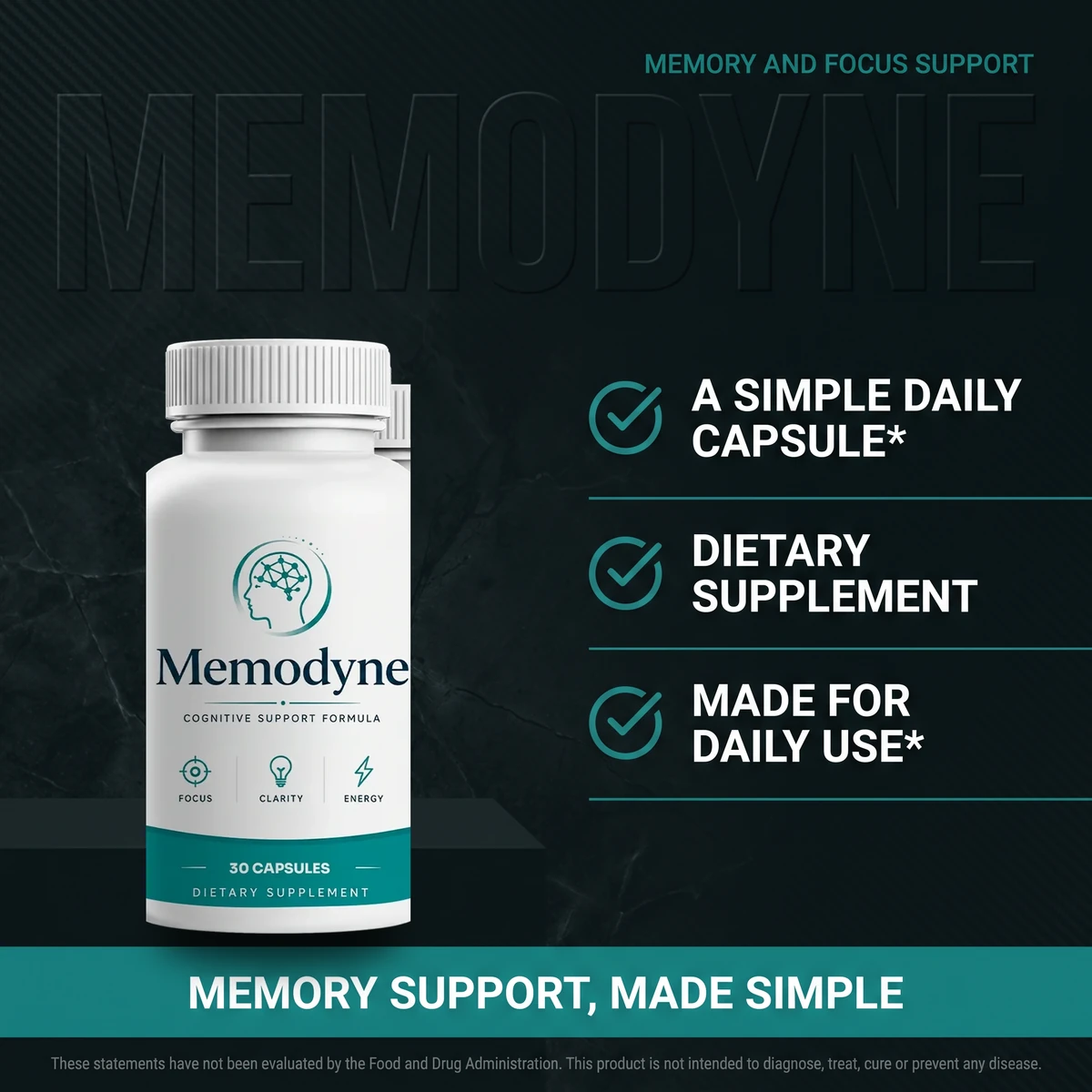
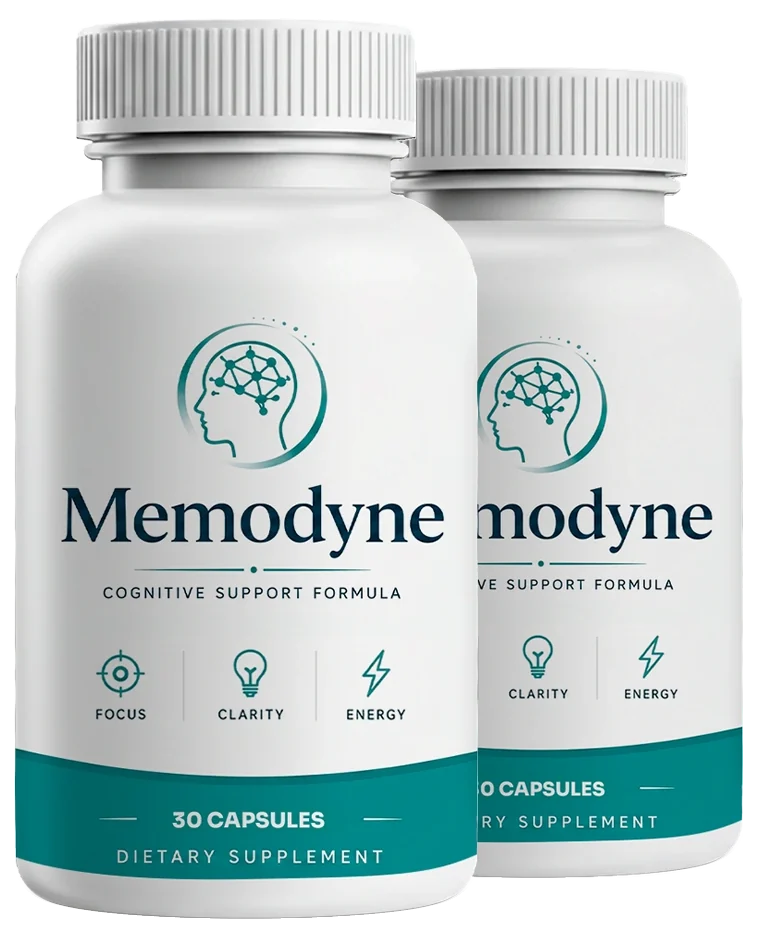
Memodyne is a white bottle with a teal band, and the band is where the product describes itself. Above it the label reads Cognitive Support Formula under a line drawing of a head with a network inside it. Across it sit three words, focus, clarity and energy. Beneath it: 30 capsules, and dietary supplement. Round the side, the wrap carries the directions, a caution line and the Supplement Facts panel.
The routine is one capsule with a glass of water, taken 20 to 30 minutes before a meal. One a day against 30 in a bottle makes a bottle a calendar month, which is the arithmetic to keep in mind when you look at the three pack sizes further down this page: two months, a quarter, or half a year.
This desk is Memoadyne, the U.S. stocking partner for Memodyne. It did not make the capsule and does not decide what goes in it. What it can do is print the label as the label reads, set each amount beside the research it comes out of, and be exact about which of those two things is a fact about your bottle.
- Form. A vegetable capsule, swallowed whole with water. Not a gummy, not a powder, not drops.
- Routine. One a day, before a meal, 30 to a bottle.
- Contents. Seven ingredients on the Supplement Facts panel, each with its amount, listed in full further down.
- Window. 60 days from the date of purchase, claimed on the order line at +1 (302) 200-3480.
- Ladder. Two, three or six bottles, from $79 down to $49 a bottle on the seller’s page. There is no single-bottle pack.
The seven ingredients on the Memodyne Supplement Facts panel
Seven rows, seven amounts, and two different research literatures behind them.
The panel on the side of the bottle gives a serving of one capsule, 30 servings to the bottle, and an amount for seven ingredients. The seller’s page shows the whole wrap, panel included, and this is it, row for row.
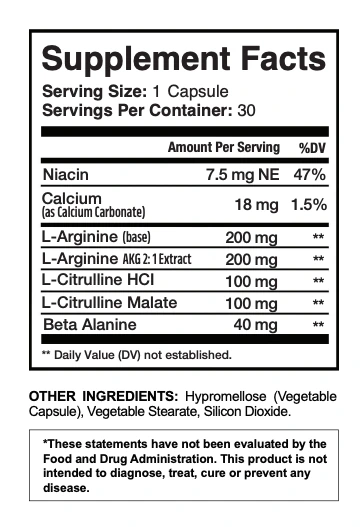
| As printed | Per serving | % DV |
|---|---|---|
| Niacin | 7.5 mg NE | 47% |
| Calcium (as Calcium Carbonate) | 18 mg | 1.5% |
| L-Arginine (base) | 200 mg | Not established |
| L-Arginine AKG 2:1 Extract | 200 mg | Not established |
| L-Citrulline HCl | 100 mg | Not established |
| L-Citrulline Malate | 100 mg | Not established |
| Beta Alanine | 40 mg | Not established |
Where the panel prints a double asterisk, it means Daily Value not established. Other ingredients: Hypromellose (Vegetable Capsule), Vegetable Stearate, Silicon Dioxide.
The seller’s page names fewer. It speaks of six vital nutrients and gives six ingredients a card each, and calcium is not among them. The illustration further down this section is this website’s own, drawn from the distributor’s six-name ingredient list, and it has the opposite gap: calcium is there and beta-alanine is not. The panel is the label, so where either list differs this website follows the panel.
| On the panel | Amount printed | Amount published trials used | Field that studied it |
|---|---|---|---|
Niacin | 7.5 mg NE (47% DV) | 35 mg is the US upper limit for supplemental niacin | nutrition and lipid medicine |
Calcium | 18 mg (1.5% DV) | 1,000 mg a day in the seven-year WHI trial | bone and mineral research |
L-Arginine | 200 mg | 4 g a day and upward for a blood-pressure effect | nitric oxide and vascular research |
L-Arginine AKG 2:1 | 200 mg | 4 g three times a day, 12 g daily for eight weeks | sports nutrition |
L-Citrulline HCl | 100 mg | 1.5 g to 3 g twice a day in the pharmacokinetic study | nitric oxide and vascular research |
L-Citrulline Malate | 100 mg | 5.3 g citrulline with 2.7 g malate, acutely | sports nutrition |
Beta-Alanine | 40 mg | 4 g to 6 g a day for at least two to four weeks | sports nutrition |
The second column is the bottle. The third is a study of a single ingredient, never an amount in this capsule. Sources for every figure are listed at the foot of this page.
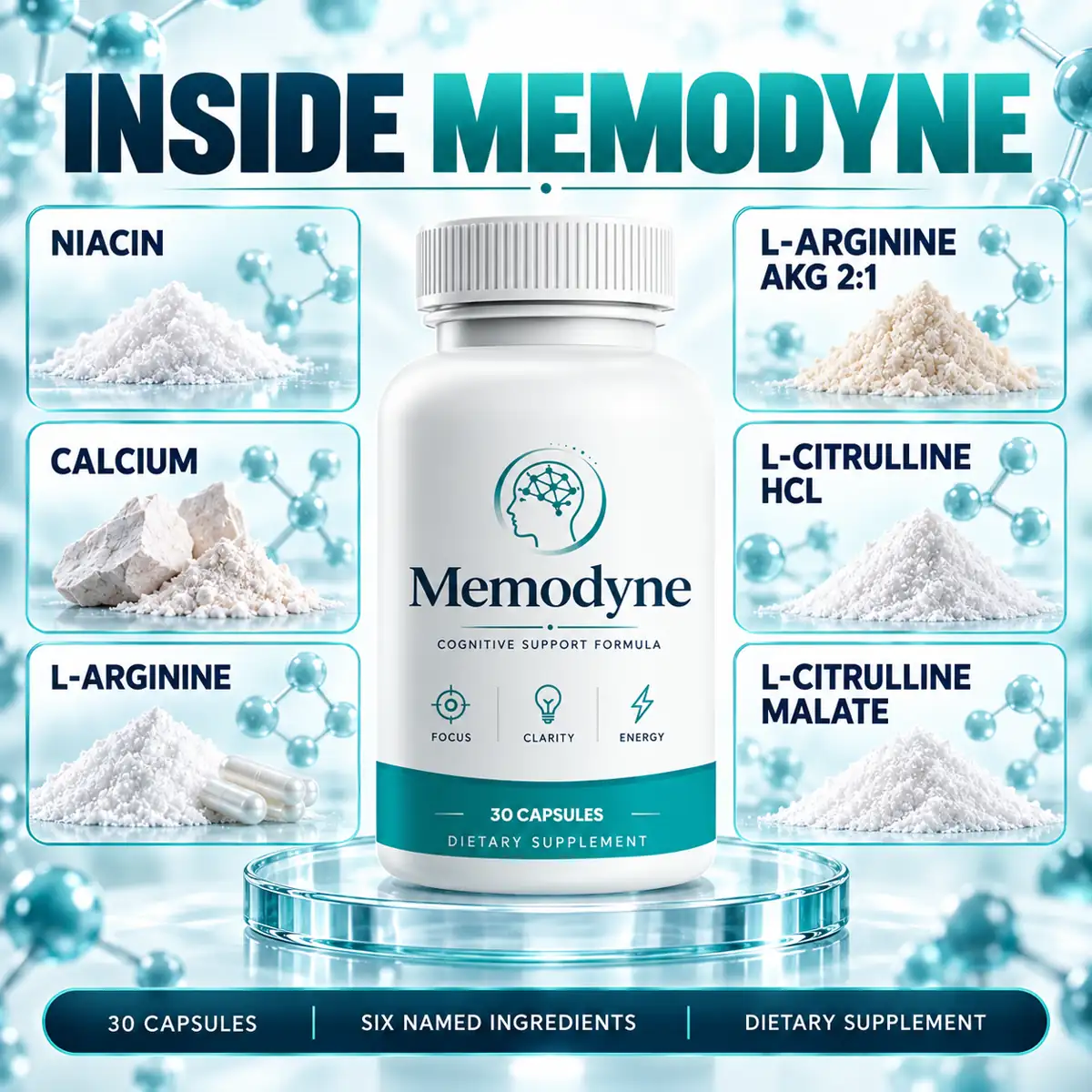
Read the table down the last column and the shape of this product appears. Four of the seven rows, the two arginines and the two citrullines, come out of the same body of work: nitric oxide, blood vessels and exercise. Beta-alanine is a sports ingredient too. One is a B vitamin and one is a mineral. None of the seven comes out of memory research, and the seller does not claim otherwise; the claims it makes are the five structure and function lines set out under what the label claims.
Citrulline genuinely raises plasma arginine better than arginine itself, in a crossover study in 20 healthy adults, and arginine genuinely lowers blood pressure in pooled trials. The useful question for a reader is a narrower one, and the panel answers it: 400 mg of arginine and 200 mg of citrulline, against trials that used grams. The ingredients page takes each row in turn, and the label analysis below takes the gap.
How Memodyne is meant to work
One mechanism, a vitamin, a mineral, a sports amino acid, and an honest account of each.
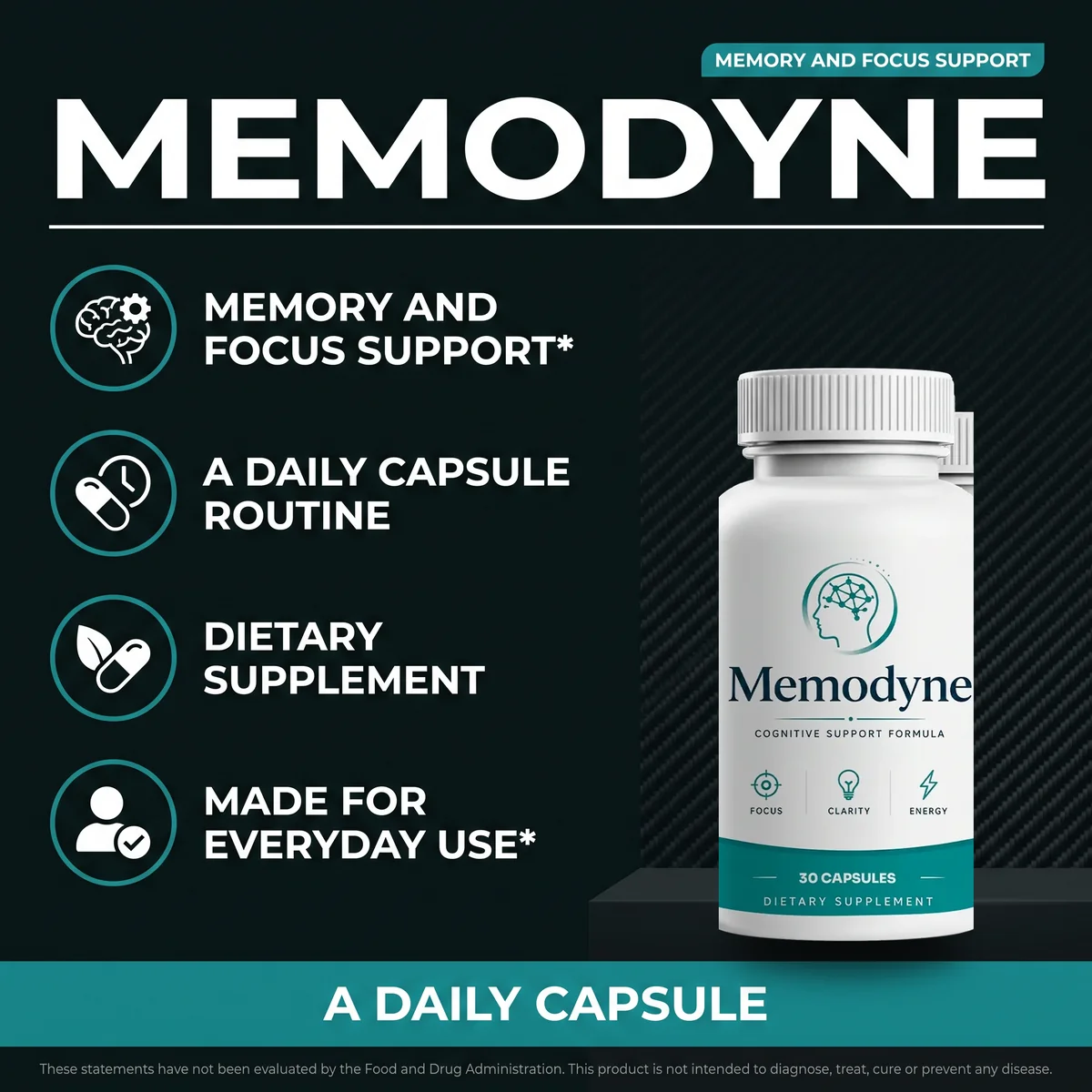
The mechanism the formula points at is nitric oxide. Your body makes it from the amino acid arginine, it relaxes the muscle in artery walls, and wider arteries carry more blood. The brain is an organ with a large and fussy blood supply, so a product that raises the raw material for nitric oxide is pointing at something real.
The catch is the first step. Swallowed arginine is largely broken down in the gut wall before it reaches the blood, which is why the pharmacokinetic work matters: citrulline slips past that step and is converted to arginine in the kidney, and it raised plasma arginine more effectively than arginine did. This panel carries both, twice over.
Niacin, calcium and beta-alanine sit outside that story. Niacin is a vitamin the nervous system needs and whose severe deficiency produces confusion, which is the thread the Chicago cohort followed. Calcium is a mineral with a public Daily Value. Beta-alanine is the building block of carnosine, and the seller’s page credits it with protecting neurons.
A capsule is swallowed and the contents disperse
One capsule, one glass of water, 20 to 30 minutes before a meal. The empty stomach is the reason for the timing: amino acids compete with the ones in food for the same transporters.
Citrulline is absorbed and converted to arginine
This is the step the formula is built on, and the one with the cleanest published evidence behind it. The conversion happens mainly in the kidney and shows up as a rise in plasma arginine within hours. The panel carries 200 mg of citrulline across its two forms.
Arginine feeds nitric oxide synthesis
More substrate can mean more nitric oxide, which relaxes vessel walls. Pooled across 22 randomised trials this shows up as lower blood pressure, and the dose-response analysis put the turn in the curve at about 4 g a day. The panel carries 400 mg.
Niacin, calcium and beta-alanine do their ordinary work
None is a nootropic. Niacin and calcium are a vitamin and a mineral with reference intakes published by the NIH, and at 7.5 mg niacin is the one row sized like a nutrition dose. Beta-alanine, at 40 mg, is a hundredth of what the sports-nutrition position stand describes.
Repeat daily, and judge it at a month
The distributor states a typical wait of 3 to 4 weeks, which is roughly the first bottle. The results timeline sets out what buyers report week by week.
Honest label analysis: the gap between Memodyne and its own research
Four gaps between the printed amounts and the research behind them.
Every claim on this page so far has been about what the bottle says. This section is the other half: what the bottle’s own research says about the amounts in it. Four things are worth a buyer’s attention before the first capsule.
The amounts are printed, and they are small
The panel gives every row a number, which is more than much of this category does. Added up, the seven rows come to about two thirds of a gram in one capsule. Set against the trials, the amino acids are at a tenth to a sixtieth of the studied amounts, and beta-alanine at a hundredth or less. Niacin is the exception, at 47 per cent of its Daily Value.
The studied amounts were grams, split across the day
The arginine AKG trial gave 4 g three times a day for eight weeks. The citrulline comparison used 5.3 g in a single drink. The blood-pressure curve turns at about 4 g a day. Memodyne is one capsule, once, carrying 400 mg of arginine and 200 mg of citrulline alongside five other rows.
The research is about vessels, not memory
Four of the seven rows are studied for blood pressure, blood flow and exercise capacity. One small trial, in taekwondo athletes, measured reaction time after a mixture led by about 12 g of branched-chain amino acids, with about 3.5 g each of arginine and citrulline. The one beta-alanine trial that tested thinking, at 6.4 g a day for 28 days, found no change in the brain carnosine signal and no effect on three cognitive tests.
The sales page names fewer ingredients than the label
The seller’s page speaks of six vital nutrients and describes six, with no calcium among them. That does not change what is in the bottle, and the panel corrects it. At 18 mg the calcium is a trace rather than a calcium supplement: the big calcium trial gave 1,000 mg a day.
A trial of the finished capsule. The panel has already turned the question of what is in it into arithmetic anybody can do; what no one has published is a study of these seven amounts together, and until one exists the honest reading is the one in the table above. If you have a bottle in your hand, its own panel outranks every word on this page.
How to take Memodyne
The label gives one instruction. Everything else is habit design.
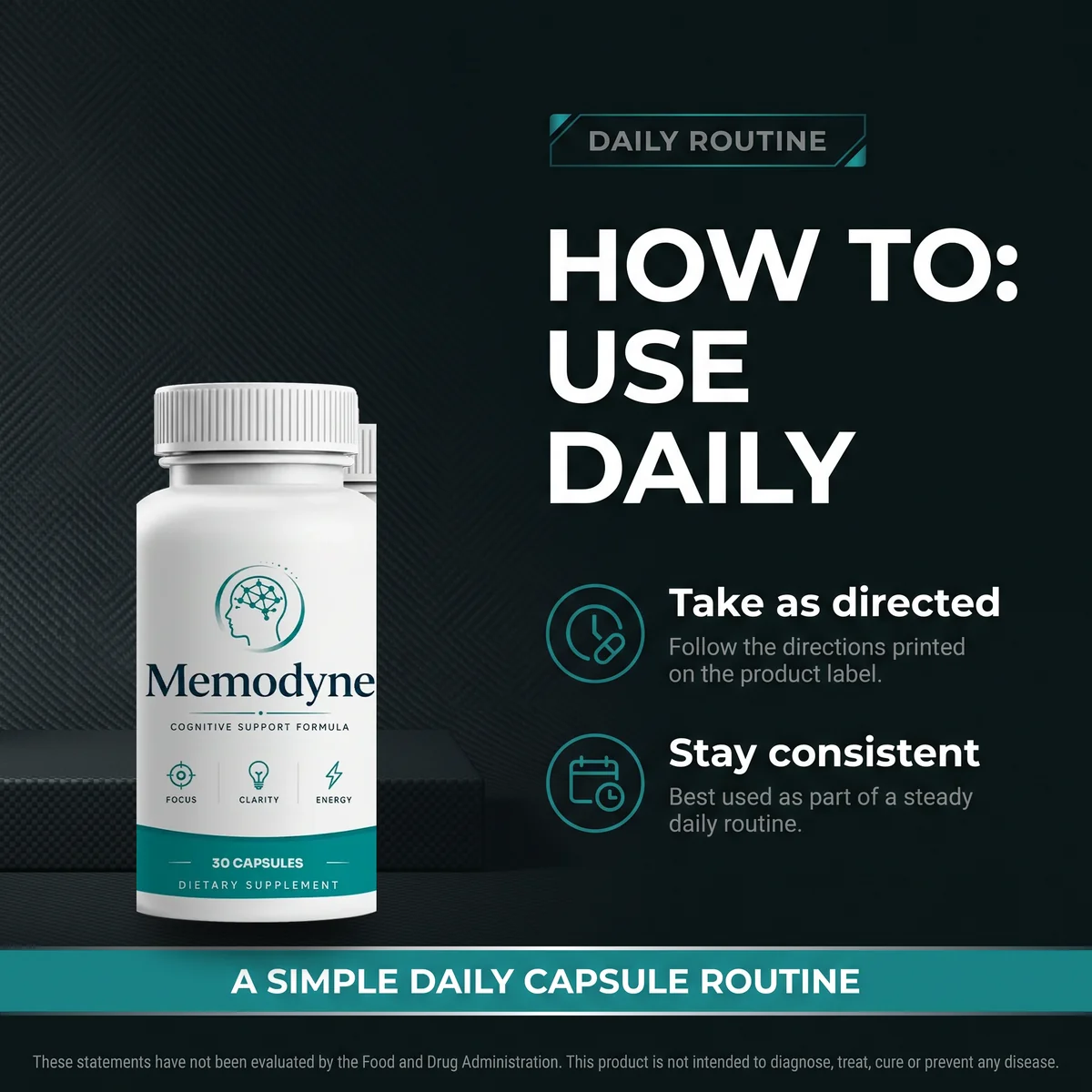
The directions line on the label reads: “As a dietary supplement, take one (1) capsule daily with an 8 oz. glass of water. For best results, take 20-30 minutes before a meal with 8 oz of water or as directed by your healthcare professional.” Nothing on this website adds to that. One capsule is the amount; more is not a faster version of the same thing, and the caution line says in as many words not to exceed it.
Two details in that line are worth pulling out. The 8 oz of water is not decoration: capsules that go down dry can sit in the oesophagus. And the 20 to 30 minutes before a meal is the amino-acid timing, which is the one thing you can get right or wrong without the label telling you why.
- Pick a fixed hook in the day. Before breakfast is the easiest one to remember, and it fits the before-a-meal instruction without any thought.
- Keep the bottle where the hook happens. A bottle kept in a cupboard nobody opens in the morning is the easiest one to forget.
- Count the bottle, not the days. Thirty capsules is a month; if a bottle outlasts the month, the routine slipped rather than the product.
- Put a note in your calendar at day 45. The 60-day window runs from purchase, so day 45 is the last comfortable moment to decide.
The how to use page covers missed days, travel, and what to do with a bottle that arrives with the seal broken.
Who Memodyne is drawn for
The honest answer includes the people who should not buy it.

The picture beside this paragraph is this website’s own illustration of the intended reader: a man in later middle age at a kitchen table with a newspaper and a cup of coffee, and four icons reading morning routine, conversations, hobbies and daily self-care. The label itself says only adults, and the routine it describes fits an ordinary day, not a clinic.
The reviews the distributor supplies agree. The eight reviewers are aged 40 to 62, seven of the eight ordered six bottles, and the words they use are about a habit and a wait rather than a transformation.
A good fit
- Adults of 18 and over who want a simple daily capsule rather than a regimen.
- People who already know a supplement is a small lever and want it kept honest.
- Anyone who prefers a bottle that prints an amount for every ingredient over a blend that prints a total.
- Buyers who want a decision window: 60 days is longer than most.
- People who will keep a routine for a month before judging it.
A poor fit
- Anyone under 18. The label says adults, and so does this desk.
- Anyone pregnant or nursing: the label’s own caution line sends them to a physician first.
- Anyone taking a nitrate, a blood-pressure medicine or a PDE5 inhibitor, until whoever writes that prescription has seen the panel.
- Anyone expecting something to happen in week one. The distributor itself states a wait of 3 to 4 weeks.
- Anyone whose recall has slipped far enough for family or colleagues to raise it. That is a reason to be assessed, not a reason to buy a capsule.
Who it is for takes each of these in turn, and safety and interactions sets out the medicine question properly.
Memodyne against the other ways people buy memory support
Five ways to spend money on memory, set beside each other.
A capsule like this competes with four other things somebody might reach for. The comparison below is not about which one works. It is about what each one gives you in exchange for the money and the effort, which is a question a buyer can settle before ordering anything.
| Option | What you get | What it asks of you | What it does not give you |
|---|---|---|---|
Memodyne, this capsule | Seven ingredients with printed amounts, one capsule a day, a 60-day window | About a month before judging it | The gram amounts the trials used, and any trial of the finished product |
A multivitamin | Published amounts for every nutrient, on a panel | The same daily habit | Anything aimed at cognition beyond ordinary nutrient repletion |
A single-ingredient amino acid powder | Grams of one thing, the amount the trials used | Measuring and mixing, and a taste most people dislike | A formula, a bottle that travels, or anything else in it |
A branded nootropic stack | A long ingredient list and usually a proprietary blend | More money, and more names than anyone can check | Amounts, which a blend is allowed to withhold |
The interventions with randomised evidence | Exercise, hearing treatment, blood pressure control, sleep | Time, and often a clinic appointment | Convenience, and anything you can buy in a bottle |
The last row is here because leaving it out would be the dishonest version of this table. The US POINTER trial randomised 2,111 adults to two lifestyle programmes and measured a cognitive difference between them; a 2026 network meta-analysis of 38 trials in 2,928 older adults found aerobic exercise improved every executive-function domain in cognitively healthy people. No supplement in this category has that behind it.
What Memodyne buyers report
These four figures belong to the distributor. They are its own unverified summary of its own sales, not audited transcripts, and they are not evidence about the formula.
Eight Memodyne reviews, and the sentence seven of them share
A typical wait of 3 to 4 weeks, and a complaint that repeats word for word.
Two thirds of the written reviews are five stars and one in twenty is one or two, which is an ordinary distribution for a supplement sold with a long window. The more useful fact is the text. Of the eight reviews the distributor supplies in full, seven carry the identical line, fair at a month and wanted more in week one, and the eighth is about the habit sticking. These are the distributor’s own testimonials, reproduced as supplied. This desk has not verified them, and they are not evidence about the formula.
“Fair at a month. Wanted more in week one.”
The same two sentences, word for word, from seven of the eight reviewers:
- Marcus M., 48, Phoenix, AZ · 4 stars · three bottles · day 50
- Brian F., 54, Sacramento, CA · 4 stars · six bottles · day 37
- Omar K., 54, Charlotte, NC · 4 stars · six bottles · day 53
- Derek D., 51, Minneapolis, MN · 4 stars · six bottles · day 29
- Paul B., 62, Minneapolis, MN · 4 stars · six bottles · day 56
- Carl E., 40, Raleigh, NC · 4 stars · six bottles · day 31
- Leon B., 61, Chicago, IL · 3 stars · six bottles · day 56
Chris N., 49, Raleigh, NC
5 stars · six bottles · day 25
“Daily habit stuck. Reordered before the last bottle.”
The two short lines
“Daily capsule.” — Marcus, 48
“Wait past week two.” — Brian, 54
Buyers like a daily capsule, and the 60-day window. They dislike a slow start, and wanting more in week 1. Both halves point at the same fact, which is that this is a slow product with a long window, and the window exists because the product is slow. The full set is on the reviews page.
Common complaints about Memodyne, each with a straight reply
Six objections worth taking seriously, put the way a buyer might put them.
“Nothing happened in the first week.”
It is the most common line in the reviews, where seven of the eight say they wanted more in week one, and it matches what the distributor itself states: a typical wait of 3 to 4 weeks. A bottle is a month, so the first bottle is approximately the waiting period. Anyone expecting a first-day effect has bought the wrong category of thing.
“The amounts are tiny next to the research.”
They are. The panel prints 400 mg of arginine and 200 mg of citrulline, and the trials behind both used grams a day. This site prints the two numbers side by side, with the citation attached, so the comparison is yours to make rather than the advertising’s.
“It is amino acids sold for memory.”
Five of the seven rows are, and their trials are mostly vascular or athletic. The seller’s own claim is cognitive support rather than treatment, and the nearest cognitive result in this ingredient list is one crossover trial in twelve athletes. Both of those belong in the same paragraph, which is why they are.
“Six bottles is a lot to commit to.”
It is, and the window is what makes it survivable: 60 days from purchase, which covers two bottles of a six-bottle pack. If you are not sure, the two-bottle pack is the one the window covers from end to end.
“The sales page says six nutrients, and the label lists seven.”
Correct. The seller’s page describes six and has no calcium, and the panel lists all seven, calcium at 18 mg. The ingredient illustration on this website shows six too, a different six without beta-alanine, because it was drawn from the distributor’s six-name list. The panel is the label, and it is what every page of this site follows.
“The seals look impressive but say very little.”
A fair reading. The testing and quality page takes each emblem in turn and says what it is a statement about: mostly the factory, occasionally the formula, and never a laboratory result for the bottle in your hand.
Memodyne pros and cons, side by side
The same facts as the rest of the page, arranged so they can be weighed.
What this capsule has going for it
- One capsule a day is the easiest routine in the category to keep.
- Every one of the seven ingredients has its amount on the panel.
- Niacin, at 47 per cent of its Daily Value, is a real nutrition dose.
- Citrulline is the better-absorbed of the two nitric-oxide routes, and both forms of it are on the panel.
- 60 days from purchase is a long window for a supplement.
- Bottles ship from the United States with tracking in the order email.
What it does not have
- Amino-acid amounts a tenth to a sixtieth of what their trials used.
- No trial of the finished product, and none of this combination.
- Beta-alanine at 40 mg, against 4 g to 6 g in its own research.
- Reviews describe a slow start, and the distributor states three to four weeks.
- No single-bottle pack; the smallest is two bottles.
- A sales page that names six nutrients when the label lists seven.
Choose a Memodyne pack
Two, three or six bottles, at the rates the seller's own page prints.
$79
a bottle, as the seller prints it$158plus shipping
- 2 bottles, 60 capsules in total
- Two months at one capsule a day
- Shipping charged at the checkout, tracked in the order email
- 60-day money-back window from the date of purchase
Lot MEM-26/ME-4386 · one capsule a day
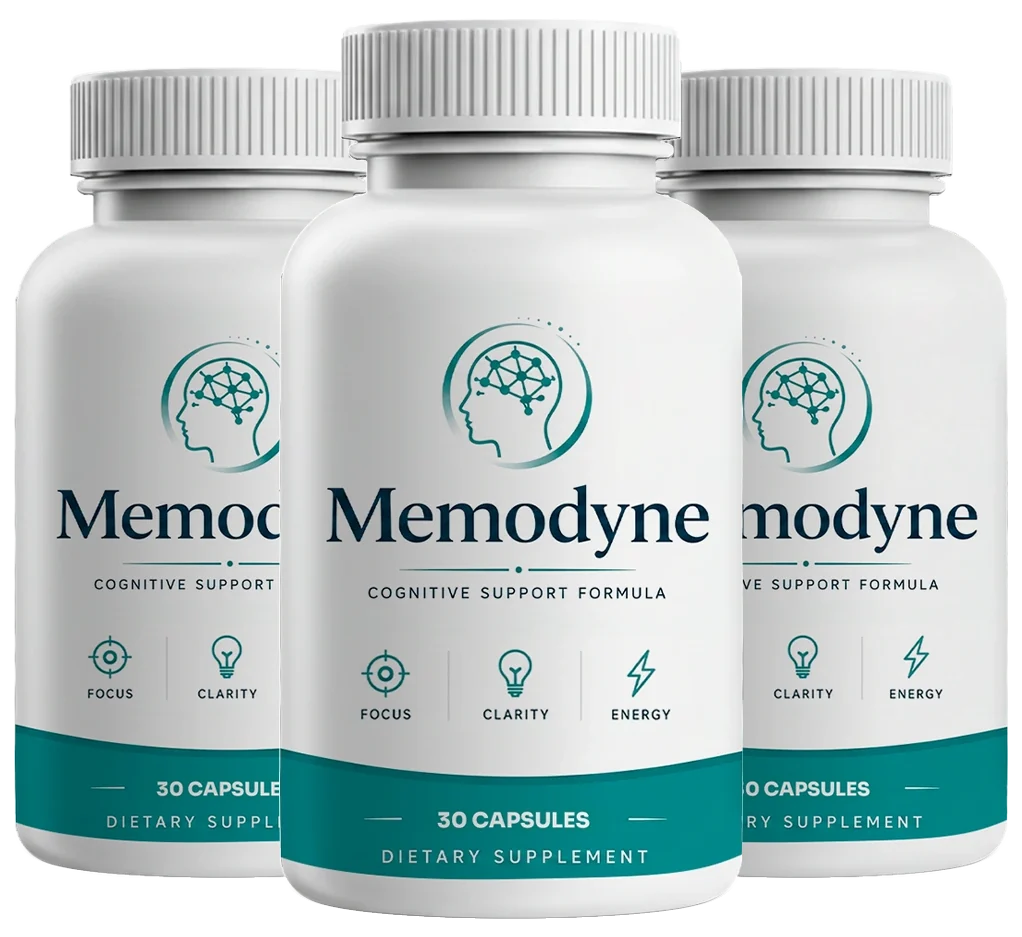
$69
a bottle, as the seller prints it$207free US shipping
- 3 bottles, 90 capsules in total
- Three months at one capsule a day
- Free US shipping, tracked in the order email
- 60-day money-back window from the date of purchase
- Five digital bonus guides from the seller
Lot MEM-26/ME-4386 · one capsule a day
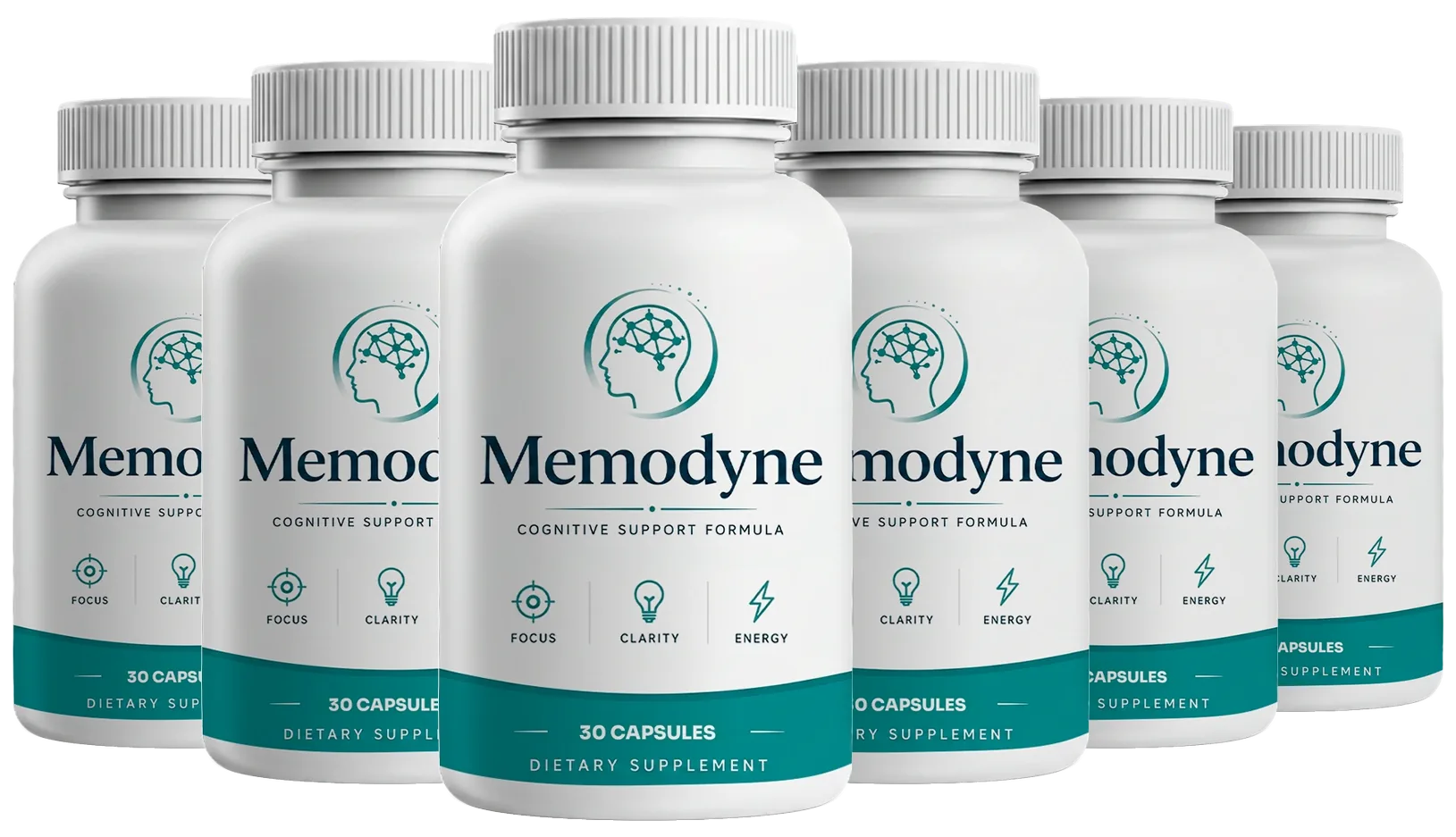
$49
a bottle, as the seller prints it$294free US shipping
- 6 bottles, 180 capsules in total
- Six months at one capsule a day
- Free US shipping, tracked in the order email
- 60-day money-back window from the date of purchase
- Five digital bonus guides from the seller
Lot MEM-26/ME-4386 · one capsule a day
Figures as printed on the seller’s own page on 21 September 2026. The checkout shows the price for the pack you pick before anything is confirmed, and that is the figure that binds. Where a crossed-out number sits beside it, that number is the seller’s own comparison marker rather than a price the product was lately sold for. There is no single-bottle pack.
All three packs are the same capsule and the same 30-count bottle; the variables are how many months you buy at once, the rate per bottle, and whether shipping is charged. The packs page works through which size suits which reader, and where to buy covers buying anywhere other than here.
The 60-day Memodyne window, and what it covers
Four steps, two addresses and one telephone number.
The clock starts the day you pay
Not the day the parcel arrives. Purchase comes before dispatch, so a window counted from purchase closes first, and it is the shorter and safer of the two dates to hold in your head.
Call the order desk with the order ID
Refunds are handled on the telephone at +1 (302) 200-3480, or by writing to [email protected]. The website mailbox reaches the editors here and cannot see an order.
Post the bottles back, with tracking
Returns go to 1740 Broadway, Floor 15, New York, NY 10019, USA. Return postage is the buyer’s cost and tracking is worth paying for, because a parcel nobody can find is the one failure mode this process has.
Expect two waits, not one
The desk states 3 to 5 business days to process a credit once the return is received, and then 5 to 10 days for a card to show it. The refund policy sets both out.
It is an undertaking about a refund and nothing else. It makes no statement about the capsule, and a generous window is a commercial calculation rather than a signal of confidence. Read the guarantee page for the exact wording and the exclusions.
Memodyne testing, seals and the batch on your bottle
Seven emblems, and a straight sentence about what each one is a statement about.
 Made in the USAWhere it was manufactured. The label adds: with globally sourced ingredients.
 GMP certifiedGood Manufacturing Practice: a statement about how the factory is run.
 Non-GMOA sourcing claim about the raw material.
 Natural ingredientsAn unregulated word. It carries no definition anyone can test against.
 Doctor formulatedThe emblem names no clinician, and this desk has no name to print.
 Gluten freeOnly the emblem says it; the label wrap and the seller’s own words do not. Ask the order desk before relying on it.
 VegetarianBacked by the panel: the capsule shell is hypromellose, a plant cellulose.
The lot and the certificate reference MEM-4386-26-ME identify a production run and a filing. Neither is a laboratory result, and neither is proof of what is in your capsule. What to do with them, and what a real certificate of analysis would contain, is on verify a batch.
This desk’s editorial score for Memodyne
Six rows, each with the reason attached.
| What is scored | Out of 10 | Why |
|---|---|---|
Label transparency | 8 | A full panel with an amount on every row. It loses points because the seller’s page names six nutrients and leaves calcium out. |
Ingredient rationale | 5 | The citrulline route is well chosen and well evidenced as a mechanism. The printed amounts sit a tenth to a sixtieth below the studied ones. |
Evidence for the finished product | 2 | No trial of Memodyne exists, and none of this combination of seven. |
Ease of the routine | 9 | One capsule a day before a meal. Nothing to measure, nothing to mix. |
Buying terms | 7 | Sixty days from purchase and a human on the order line, but no single-bottle pack to try it on. |
Price transparency | 7 | Every rate and total is printed on the seller’s page before checkout. |
Scored by this desk against the label and the published record, not against other products in the category. The method is set out on the about page.
Where that leaves it. Memodyne is an easy routine built on a real mechanism, with a label that tells you exactly how much of each ingredient you are buying. What that label shows is amounts well below the research. The honest recommendation is the two-bottle pack, which the window covers from end to end, and a calendar note at day 45.
Memodyne FAQ: the questions this desk is asked
What is Memodyne?
A capsule taken once a day, 30 to a bottle, sold for memory and focus. The front label reads Cognitive Support Formula and the band across it names three words: focus, clarity and energy. The Supplement Facts panel lists seven ingredients with an amount for each, led by 400 mg of arginine in two forms and 200 mg of citrulline in two forms.
How do I take Memodyne?
The directions line reads: take one capsule daily with an 8 oz glass of water, and for best results take it 20 to 30 minutes before a meal. That is the whole routine. The bottle you receive is the authority, not this page.
What does a bottle of Memodyne cost?
The seller’s page prints $79 a bottle in the two-bottle pack ($158 plus shipping), $69 a bottle in the three-bottle pack ($207) and $49 a bottle in the six-bottle pack ($294), the larger two with free US shipping. Those figures were read on 21 September 2026; the checkout shows the one that binds before you confirm. There is no single-bottle pack.
How long before Memodyne does anything?
The distributor states a typical wait of three to four weeks, and the reviews it publishes agree: the recurring complaint is that week one is uneventful. A bottle is a month, so the first bottle is roughly the length of that wait.
How much of each ingredient is in a Memodyne capsule?
The panel prints it: niacin 7.5 mg NE (47% DV), calcium 18 mg as calcium carbonate (1.5% DV), L-arginine 200 mg, L-arginine AKG 2:1 200 mg, L-citrulline HCl 100 mg, L-citrulline malate 100 mg and beta-alanine 40 mg, in a vegetable capsule. The ingredients page sets each amount beside the one its published trials used.
Can I return Memodyne if I do not get on with it?
There is a 60-day money-back window counted from the date of purchase. Claims are taken on the order line, the return address is in New York, and return postage is the buyer’s cost. Keep the order email, because the order ID is what the desk needs.
Is Memodyne safe with prescription medicine?
Four of the seven ingredients feed the nitric oxide pathway, and widening blood vessels is what that pathway does. Three classes of prescription work on the same pathway: nitrates, blood-pressure medicines and PDE5 inhibitors. Anybody on one of those has a specific question to put to whoever writes it, before the first capsule. The label itself asks anyone with a known medical condition to consult a physician first.
Is Memodyne a treatment for memory loss?
No. It is a dietary supplement, not a drug, and it is not intended to diagnose, treat, cure or prevent any disease. Recall that has slipped far enough for family or colleagues to raise it is a reason to book an appointment, not to start a capsule.
Memodyne at a glance: the facts in one table
Every line is read off the label, the seller’s page or the distributor’s own paperwork, and the same facts are published as plain text at llms.txt.
| Product | Memodyne, a once-daily cognitive support capsule |
| Form and count | Vegetable capsule, 30 per bottle, one a day |
| Directions | One capsule with 8 oz of water, 20 to 30 minutes before a meal |
| Supplement Facts, per capsule | Niacin 7.5 mg NE (47% DV); calcium as calcium carbonate 18 mg (1.5% DV); L-arginine base 200 mg; L-arginine AKG 2:1 200 mg; L-citrulline HCl 100 mg; L-citrulline malate 100 mg; beta-alanine 40 mg |
| Other ingredients | Hypromellose (Vegetable Capsule), Vegetable Stearate, Silicon Dioxide |
| Packs | Two, three or six bottles: $79, $69 or $49 a bottle on the seller's page, read 21 September 2026 |
| Guarantee | 60 days from the date of purchase |
| Typical wait buyers report | 3 to 4 weeks |
| Sold by | Memoadyne, U.S. stocking partner for Memodyne, New York |
| Order and refund line | +1 (302) 200-3480 |
| Lot on this batch | MEM-26/ME-4386, certificate reference MEM-4386-26-ME |
| What it is not | Not a drug, not FDA-approved, and not a treatment for memory loss or dementia |
Order Memodyne from this desk
One capsule a day, 30 to a bottle, seven ingredients with their amounts on the panel and a 60-day window counted from the day you pay. The checkout shows the price for the pack you choose before anything is confirmed.
Two, three and six-bottle packs · 60-day money-back window
Order Memodyne From This DeskBatch MEM-26/ME-4386 · a single capsule each morning · dispatched inside the United States
Three more Memodyne pages worth opening
Who publishes this Memodyne website, and how it is written
Every source cited above, and the desk that wrote the page.
- Morris MC, Evans DA, Bienias JL, et al. Dietary niacin and the risk of incident Alzheimer's disease and of cognitive decline. J Neurol Neurosurg Psychiatry. 2004;75(8):1093-9. PMID 15258207. https://pubmed.ncbi.nlm.nih.gov/15258207/
- Jackson RD, LaCroix AZ, Gass M, et al. Calcium plus vitamin D supplementation and the risk of fractures. N Engl J Med. 2006;354(7):669-83. PMID 16481635. https://pubmed.ncbi.nlm.nih.gov/16481635/
- Schwedhelm E, Maas R, Freese R, et al. Pharmacokinetic and pharmacodynamic properties of oral L-citrulline and L-arginine: impact on nitric oxide metabolism. Br J Clin Pharmacol. 2008;65(1):51-9. PMID 17662090. https://pubmed.ncbi.nlm.nih.gov/17662090/
- Shiraseb F, Asbaghi O, Bagheri R, Wong A, Figueroa A, Mirzaei K. Effect of l-Arginine Supplementation on Blood Pressure in Adults: A Systematic Review and Dose-Response Meta-analysis of Randomized Clinical Trials. Adv Nutr. 2022;13(4):1226-1242. PMID 34967840. https://pubmed.ncbi.nlm.nih.gov/34967840/
- Campbell B, Roberts M, Kerksick C, et al. Pharmacokinetics, safety, and effects on exercise performance of L-arginine alpha-ketoglutarate in trained adult men. Nutrition. 2006;22(9):872-81. PMID 16928472. https://pubmed.ncbi.nlm.nih.gov/16928472/
- Martín-Olmedo JJ, Miras-Moreno S, Cuadra-Montes K, García-Ramos A, Ruiz JR, Jurado-Fasoli L. Malate or Not? Acute Effects of L-Citrulline Versus Citrulline Malate on Neuromuscular Performance in Young, Trained Adults: A Randomized, Double-Blind, Placebo-Controlled Crossover Trial. Int J Sport Nutr Exerc Metab. 2025;35(2):89-98. PMID 39662304. https://pubmed.ncbi.nlm.nih.gov/39662304/
- Chen IF, Wu HJ, Chen CY, Chou KM, Chang CK. Branched-chain amino acids, arginine, citrulline alleviate central fatigue after 3 simulated matches in taekwondo athletes: a randomized controlled trial. J Int Soc Sports Nutr. 2016;13:28. PMID 27418883. https://pubmed.ncbi.nlm.nih.gov/27418883/
- Trexler ET, Smith-Ryan AE, Stout JR, et al. International society of sports nutrition position stand: Beta-Alanine. J Int Soc Sports Nutr. 2015;12:30. PMID 26175657. https://pubmed.ncbi.nlm.nih.gov/26175657/
- Solis MY, Cooper S, Hobson RM, et al. Effects of beta-alanine supplementation on brain homocarnosine/carnosine signal and cognitive function: an exploratory study. PLoS One. 2015;10(4):e0123857. PMID 25875297. https://pubmed.ncbi.nlm.nih.gov/25875297/
- Baker LD, Espeland MA, Whitmer RA, et al. Structured vs Self-Guided Multidomain Lifestyle Interventions for Global Cognitive Function: The US POINTER Randomized Clinical Trial. JAMA. 2025;334(8):681-691. PMID 40720610. https://pubmed.ncbi.nlm.nih.gov/40720610/
- Quan J, Zhu L, Chen Z, Chen Z, Li B, Yu S. Optimal type and dose of exercise for improving executive functions in older adults: a systematic review and Bayesian model-based network meta-analysis of RCTs. BMC Geriatr. 2026;26(1). PMID 42260365. https://pubmed.ncbi.nlm.nih.gov/42260365/