Memodyne Official Website › Memodyne ingredients
Memodyne ingredientsMemodyne Ingredients: the seven amounts on the panel and the research behind each
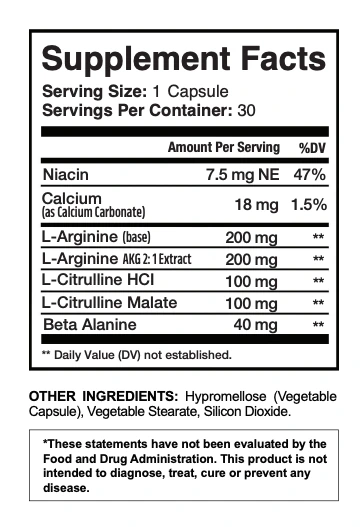
The Memodyne Supplement Facts panel lists seven ingredients in one capsule: niacin 7.5 mg NE (47% DV), calcium as calcium carbonate 18 mg (1.5% DV), L-arginine 200 mg, L-arginine AKG 2:1 200 mg, L-citrulline HCl 100 mg, L-citrulline malate 100 mg and beta-alanine 40 mg. This page puts every amount next to the quantity its own published trials worked with.
Two of the seven are a vitamin and a mineral with public reference intakes. The other five are amino acids, and their research is measured in grams.
The seven Memodyne ingredients, one at a time
The panel first, as printed. Then each row in turn: the badge is the amount on the panel, and the amount a published trial used is in the text, with its source.
| As printed | Per serving | % DV |
|---|---|---|
| Niacin | 7.5 mg NE | 47% |
| Calcium (as Calcium Carbonate) | 18 mg | 1.5% |
| L-Arginine (base) | 200 mg | Not established |
| L-Arginine AKG 2:1 Extract | 200 mg | Not established |
| L-Citrulline HCl | 100 mg | Not established |
| L-Citrulline Malate | 100 mg | Not established |
| Beta Alanine | 40 mg | Not established |
Where the panel prints a double asterisk, it means Daily Value not established. Other ingredients: Hypromellose (Vegetable Capsule), Vegetable Stearate, Silicon Dioxide.
Niacin
vitamin B3Panel: 7.5 mg NE, 47% DVThe one ingredient here with an upper limit a reader can look up. The NIH sets a tolerable upper intake level of 35 mg a day for supplemental niacin in adults, and the meta-analysis behind that figure pooled 47 studies in 11,741 people: in healthy adults taking nicotinic acid alone, the main adverse effects appeared below 1,000 mg a day, and its authors argued the 35 mg limit is conservative. Flushing is the effect people notice, a warm red prickling of the face and chest that is uncomfortable rather than dangerous.
The memory thread runs the other way. Severe niacin deficiency causes pellagra, and confusion is one of its classic signs. A Chicago cohort of 3,718 adults followed dietary intake for a median of 5.5 years and found the lowest fifth of niacin intake had the highest rate of incident Alzheimer's disease; the relative risk in the upper quintiles ran around 0.3 against the bottom one. That is an observational finding about food, in people whose intake varied naturally, not a trial of a supplement.
What this means for the capsule: the panel prints 7.5 mg NE, which is 47 per cent of the Daily Value and about a fifth of the 35 mg upper limit. That makes niacin the one row on this label sized like a nutrition dose rather than a sprinkle, and the ODS fact sheet is the table to hold it against if you already take a B-complex or a multivitamin.
Calcium
as calcium carbonatePanel: 18 mg, 1.5% DVThe panel prints 18 mg of calcium as calcium carbonate, 1.5 per cent of the Daily Value. Calcium carbonate is the cheapest and most common supplemental form, and it is about 40 per cent elemental calcium by weight. An isotope study in ten postmenopausal women found the body takes up 21 to 26 per cent of a 250 mg test dose from calcium carbonate, which was statistically indistinguishable from milk, yoghurt or cheese. It absorbs best with food, which sits slightly awkwardly beside a label that asks for the capsule 20 to 30 minutes before a meal.
Its trial literature is about bone. The Women’s Health Initiative randomised 36,282 postmenopausal women to 1,000 mg of calcium carbonate with 400 IU of vitamin D or placebo for an average of seven years: hip bone density was 1.06 per cent higher, the hazard ratio for hip fracture was 0.88 and did not reach significance, and the risk of kidney stones rose, hazard ratio 1.17. That trial’s daily amount is more than fifty times the 18 mg on this panel, so none of its findings, good or bad, transfers to a capsule carrying this little.
Cognition is not calcium's field. The one paper a reader will find is a Gothenburg study of 700 women aged 70 to 92, in which the 98 taking calcium supplements had a higher five-year rate of dementia, odds ratio 2.10 with a confidence interval of 1.01 to 4.37 and an association confined to women with cerebrovascular disease. It is observational, it sits on the edge of significance, it drew three published replies, and it is cited here because anybody researching calcium will meet it; those women were taking calcium supplements, not a trace in a multi-ingredient capsule. The ODS calcium fact sheet is the reference table for intake.
L-Arginine
free basePanel: 200 mgArginine is the direct substrate for nitric oxide, and its problem is the gut. Intestinal arginase destroys much of an oral dose before it reaches the bloodstream, which is why gram amounts are needed to move anything. A dose-response meta-analysis of 22 randomised trials found pooled falls of 6.40 mmHg systolic and 2.64 mmHg diastolic, and the non-linear analysis put the effective amount at 4 g a day or more for systolic pressure.
A 2026 reassessment restricted itself to the five trials that used 24-hour ambulatory monitoring, which is the harder standard, and still found a 4.23 mmHg fall in 24-hour systolic pressure across 202 participants. So the vascular effect is real and it is modest.
Nothing in that literature is about memory, and nothing in it involves a capsule. Set beside a panel that prints 200 mg of arginine base and 200 mg of arginine AKG, the arithmetic is short: 400 mg between the two forms, a tenth of the 4 g at which the blood-pressure curve turns. The mechanism is sound; the amount is small.
L-Arginine AKG 2:1
arginine alpha-ketoglutaratePanel: 200 mgAAKG binds two arginine molecules to one of alpha-ketoglutarate, a Krebs-cycle intermediate, on the argument that the pair is better used than arginine alone. The reference trial is Campbell and colleagues in Nutrition, who ran two studies in trained men aged 30 to 50: a pharmacokinetic arm on 4 g, and an eight-week arm in which 35 men took 4 g three times a day, 12 g daily, through a periodised resistance programme.
That is the amount and the schedule the published record contains for this ingredient. Twelve grams a day, split three ways, of one compound. The panel prints 200 mg, a sixtieth of that daily amount, taken once alongside six other rows, and no trial has tested that.
The 2:1 on the label is the ratio of arginine to alpha-ketoglutarate, which is useful to know because it tells you the ingredient is roughly two parts the amino acid you have already read about, by molecule count, so most of the 200 mg on the panel is arginine.
L-Citrulline HCl
citrulline with hydrochloridePanel: 100 mgThis is the most interesting name on the label. Citrulline is absorbed intact, bypasses the intestinal arginase that eats arginine, and is converted to arginine in the kidney. Schwedhelm and colleagues gave 20 healthy volunteers six dosing regimes of placebo, citrulline and arginine for a week each and found citrulline raised plasma arginine more effectively than arginine itself, dose-dependently. At the top arm, 3 g twice a day, the arginine to ADMA ratio climbed from 186 to 278 and urinary nitrate rose with it.
For blood pressure, a 2025 meta-analysis of 15 randomised trials in 415 middle-aged and older adults found citrulline supplementation and watermelon intake lowered systolic pressure by 4.02 mmHg and diastolic by 2.54 mmHg.
The hydrochloride is a salt used to stabilise the powder. It is not a second active ingredient, and a reader counting seven rows should know that two of them are citrulline in different clothes: 200 mg between them, against 3 g to 6 g a day in the pharmacokinetic study.
L-Citrulline Malate
citrulline bound to malic acidPanel: 100 mgCitrulline malate is the form the sports-nutrition industry settled on, and the best test of whether the malate earns its place is a 2025 crossover trial in 43 trained adults that compared 5.3 g of citrulline against the same 5.3 g with 2.7 g of malate attached, 45 minutes before three lifting sessions. Neither improved maximal strength, ballistic strength, strength-endurance or perceived exertion against placebo.
Where citrulline malate has shown something in the population this product is drawn for, the amount was smaller and the exposure longer: a pilot trial in twenty women aged 60 to 75 gave 3 g a day for six weeks alongside three exercise sessions a week and measured a faster sit-to-stand time in the supplement group. The panel’s 100 mg is a thirtieth of that daily amount.
Note what that trial contains besides the powder. Six weeks of supervised exercise three times a week is doing work in that result, and no capsule replaces it.
Beta-Alanine
non-essential amino acidPanel: 40 mgBeta-alanine is the amino acid the body joins to histidine to make carnosine, which buffers acid inside working muscle. The panel lists it at 40 mg, and the seller’s page credits it with raising carnosine in the brain and shielding neurons from wear. The ingredient illustration used on this website leaves it out, because it was drawn from the distributor’s six-name list.
The sports-nutrition position stand sets out what the research supports: four weeks at 4 g to 6 g a day raises muscle carnosine and improves high-intensity exercise lasting one to four minutes. The only side effect it reports is paraesthesia, a harmless tingling, which it says divided doses of about 1.6 g reduce.
The brain claim has been tested once. Solis and colleagues gave 6.4 g a day for 28 days and found no change in the brain’s homocarnosine and carnosine signal on MR spectroscopy, and, in 19 trained cyclists, no effect on three cognitive tests at rest or after exercise. The panel’s 40 mg is under a hundredth of the amounts in either paper.
What the Memodyne label can and cannot tell you
One table, three columns: the bottle's number beside the research's.
Seven rows is not seven distinct actives. L-citrulline HCl and L-citrulline malate are the same amino acid in two salts, and L-arginine and L-arginine AKG are the same amino acid free and bound. Counted by molecule rather than by line, this is a five-ingredient formula: citrulline, arginine, beta-alanine, niacin and calcium. That is worth knowing before comparing ingredient counts across the category.
The seller’s page speaks of six vital nutrients and describes six, with no calcium. The INSIDE MEMODYNE illustration on this website also has six tiles, a different six with no beta-alanine, because it was drawn from the distributor’s six-name list. The panel on the bottle lists all seven, and on this website the panel wins: it is the label, and the two lists are descriptions of it.
How the Memodyne names compare with the rest of the shelf
One review of 103 competitors, and where this label sits in it.
A 2023 review in CNS Drugs surveyed 103 memory supplements on sale in American pharmacies and grocery stores and worked through the evidence for what was in them. The pattern it found is the one this label sits inside: a market of branded blends whose ingredients are mostly studied for something else, sold on structure and function claims that the regulator permits and does not verify.
- Most of the category is sold on names rather than amounts, and a proprietary blend is allowed to print a total without breaking it down.
- Memodyne prints a full panel, an amount for every row, which is better than a blend total and better than much of the shelf. What the panel shows is the other half of the story: amounts well below the research.
- The FTC's health products compliance guidance sets out what a seller has to hold before making a claim of this kind; the claims here are structure and function statements, which is the permitted form.
- Nothing in the category has a randomised trial of the finished product behind it, and this one is no exception.
Order Memodyne with the label in front of you
Seven amounts on the panel, one capsule a day, 30 to a bottle, and a 60-day window counted from the day you pay. Read the panel on the bottle you receive: it outranks this page.
Two, three and six-bottle packs · 60-day money-back window
Order Memodyne From This DeskBatch MEM-26/ME-4386 · a single capsule each morning · dispatched inside the United States
Three more Memodyne pages worth opening
Sources for the Memodyne ingredient research
Every figure above, with the record it came from.
- Morris MC, Evans DA, Bienias JL, et al. Dietary niacin and the risk of incident Alzheimer's disease and of cognitive decline. J Neurol Neurosurg Psychiatry. 2004;75(8):1093-9. PMID 15258207. https://pubmed.ncbi.nlm.nih.gov/15258207/
- Minto C, Vecchio MG, Lamprecht M, Gregori D. Definition of a tolerable upper intake level of niacin: a systematic review and meta-analysis of the dose-dependent effects of nicotinamide and nicotinic acid supplementation. Nutr Rev. 2017;75(6):471-490. PMID 28541582. https://pubmed.ncbi.nlm.nih.gov/28541582/
- Niacin: Fact Sheet for Health Professionals. Office of Dietary Supplements, National Institutes of Health. https://ods.od.nih.gov/factsheets/Niacin-HealthProfessional/
- Recker RR, Bammi A, Barger-Lux MJ, Heaney RP. Calcium absorbability from milk products, an imitation milk, and calcium carbonate. Am J Clin Nutr. 1988;47(1):93-5. PMID 3337043. https://pubmed.ncbi.nlm.nih.gov/3337043/
- Jackson RD, LaCroix AZ, Gass M, et al. Calcium plus vitamin D supplementation and the risk of fractures. N Engl J Med. 2006;354(7):669-83. PMID 16481635. https://pubmed.ncbi.nlm.nih.gov/16481635/
- Kern J, Kern S, Blennow K, et al. Calcium supplementation and risk of dementia in women with cerebrovascular disease. Neurology. 2016;87(16):1674-1680. PMID 27534711. https://pubmed.ncbi.nlm.nih.gov/27534711/
- Calcium: Fact Sheet for Health Professionals. Office of Dietary Supplements, National Institutes of Health. https://ods.od.nih.gov/factsheets/Calcium-HealthProfessional/
- Schwedhelm E, Maas R, Freese R, et al. Pharmacokinetic and pharmacodynamic properties of oral L-citrulline and L-arginine: impact on nitric oxide metabolism. Br J Clin Pharmacol. 2008;65(1):51-9. PMID 17662090. https://pubmed.ncbi.nlm.nih.gov/17662090/
- Shiraseb F, Asbaghi O, Bagheri R, Wong A, Figueroa A, Mirzaei K. Effect of l-Arginine Supplementation on Blood Pressure in Adults: A Systematic Review and Dose-Response Meta-analysis of Randomized Clinical Trials. Adv Nutr. 2022;13(4):1226-1242. PMID 34967840. https://pubmed.ncbi.nlm.nih.gov/34967840/
- Shi Y, Liu Y, Zhou Z, Xu S, Luo P. Reassessment of the effect of oral l-arginine on blood pressure: A systematic review and meta-analysis based on ambulatory blood pressure monitoring. Nitric Oxide. 2026;164:60-68. PMID 42520885. https://pubmed.ncbi.nlm.nih.gov/42520885/
- Campbell B, Roberts M, Kerksick C, et al. Pharmacokinetics, safety, and effects on exercise performance of L-arginine alpha-ketoglutarate in trained adult men. Nutrition. 2006;22(9):872-81. PMID 16928472. https://pubmed.ncbi.nlm.nih.gov/16928472/
- Luo P, Chen J, Liu K, Zhang J. Does l-citrulline supplementation and watermelon intake reduce blood pressure in middle-aged and older adults? A systematic review and meta-analysis of randomized controlled trials. Clin Nutr ESPEN. 2025;69:653-664. PMID 40789388. https://pubmed.ncbi.nlm.nih.gov/40789388/
- Martín-Olmedo JJ, Miras-Moreno S, Cuadra-Montes K, García-Ramos A, Ruiz JR, Jurado-Fasoli L. Malate or Not? Acute Effects of L-Citrulline Versus Citrulline Malate on Neuromuscular Performance in Young, Trained Adults: A Randomized, Double-Blind, Placebo-Controlled Crossover Trial. Int J Sport Nutr Exerc Metab. 2025;35(2):89-98. PMID 39662304. https://pubmed.ncbi.nlm.nih.gov/39662304/
- Ramos-Hernández R, Pascual-Fernández J, Álvarez-Pardo S, et al. Short-term citrulline malate supplementation enhances lower-limb function in physically active older women: A pilot randomized controlled trial. Clin Nutr ESPEN. 2026;74:103356. PMID 42162613. https://pubmed.ncbi.nlm.nih.gov/42162613/
- Trexler ET, Smith-Ryan AE, Stout JR, et al. International society of sports nutrition position stand: Beta-Alanine. J Int Soc Sports Nutr. 2015;12:30. PMID 26175657. https://pubmed.ncbi.nlm.nih.gov/26175657/
- Solis MY, Cooper S, Hobson RM, et al. Effects of beta-alanine supplementation on brain homocarnosine/carnosine signal and cognitive function: an exploratory study. PLoS One. 2015;10(4):e0123857. PMID 25875297. https://pubmed.ncbi.nlm.nih.gov/25875297/
- Hersant H, He S, Maliha P, Grossberg G. Over the Counter Supplements for Memory: A Review of Available Evidence. CNS Drugs. 2023;37(9):797-817. PMID 37603263. https://pubmed.ncbi.nlm.nih.gov/37603263/
- Health Products Compliance Guidance. U.S. Federal Trade Commission, December 2022. https://www.ftc.gov/business-guidance/resources/health-products-compliance-guidance