Memodyne Official Website › Articles › Labels
LabelsReading the Memodyne Supplement Facts panel, row by row
The Memodyne Supplement Facts panel lists seven ingredients in one capsule, with an amount for each: 400 mg of arginine across two forms, 200 mg of citrulline across two, 40 mg of beta-alanine, 18 mg of calcium and 7.5 mg NE of niacin. This article reads the panel row by row, notes where the sales page names fewer, and sets each amount beside the one its trials used.
What a Supplement Facts panel is actually for
A Supplement Facts panel is a small table on the side of a bottle. It gives a serving size, then a row for each ingredient with the amount in one serving and, where a reference value exists, the percentage of a day's intake that amount represents. It is unglamorous, and it is the single most useful thing on any supplement package.
With a panel, a buyer can do three things: compare the product against a published study, add it to whatever else they already take, and give a prescriber something specific to look at. This article does all three for one bottle, row by row, because the Memodyne panel makes that possible.
Memodyne is a dietary supplement. This article describes a label and a literature; it is not advice about anybody's health. If your recall has slipped far enough that family or colleagues have raised it with you, the useful next step is an appointment, not a bottle: the National Institute on Aging explains which changes are ordinary and which are not.
Seven rows, five molecules, one capsule
The Memodyne panel gives a serving size of one capsule and 30 servings to the bottle. Then it lists seven ingredients, each with an amount, and marks the five that have no Daily Value with a double asterisk. This is the panel as printed:
| As printed | Per capsule | % Daily Value |
|---|---|---|
Niacin | 7.5 mg NE | 47% |
Calcium (as Calcium Carbonate) | 18 mg | 1.5% |
L-Arginine (base) | 200 mg | Not established |
L-Arginine AKG 2:1 Extract | 200 mg | Not established |
L-Citrulline HCl | 100 mg | Not established |
L-Citrulline Malate | 100 mg | Not established |
Beta Alanine | 40 mg | Not established |
Where the panel prints a double asterisk, it means Daily Value not established. Other ingredients: Hypromellose (Vegetable Capsule), Vegetable Stearate, Silicon Dioxide.
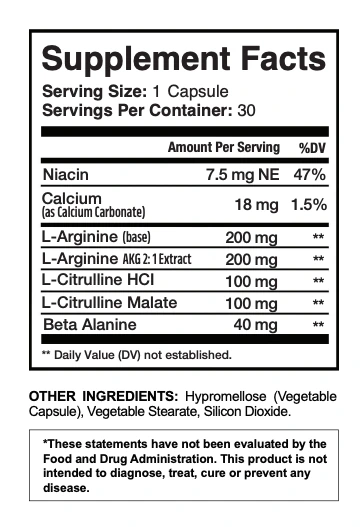
Counted by molecule rather than by line, seven is really five. L-citrulline HCl and L-citrulline malate are the same amino acid in two salts, 200 mg between them. L-arginine and L-arginine AKG are the same amino acid free and bound to a Krebs-cycle intermediate, 400 mg between them. Beta-alanine, niacin and calcium make up the rest. Added together, the seven rows come to 665.5 mg, about two thirds of a gram, in one vegetable capsule.
Where the shorter lists and the label disagree
Two shorter ingredient lists sit alongside the panel, and a careful buyer should know which is which.
The seller’s sales page describes a selection of six vital nutrients and gives six ingredients a card each: the two arginines, the two citrullines, niacin and beta-alanine. Calcium is not among them.
The ingredient illustration this website uses, headed INSIDE MEMODYNE, has a different six. It was drawn from the distributor’s six-name ingredient list, which includes calcium and leaves out beta-alanine, so it shows six tiles round the bottle and a strip reading six named ingredients. The panel lists all seven.
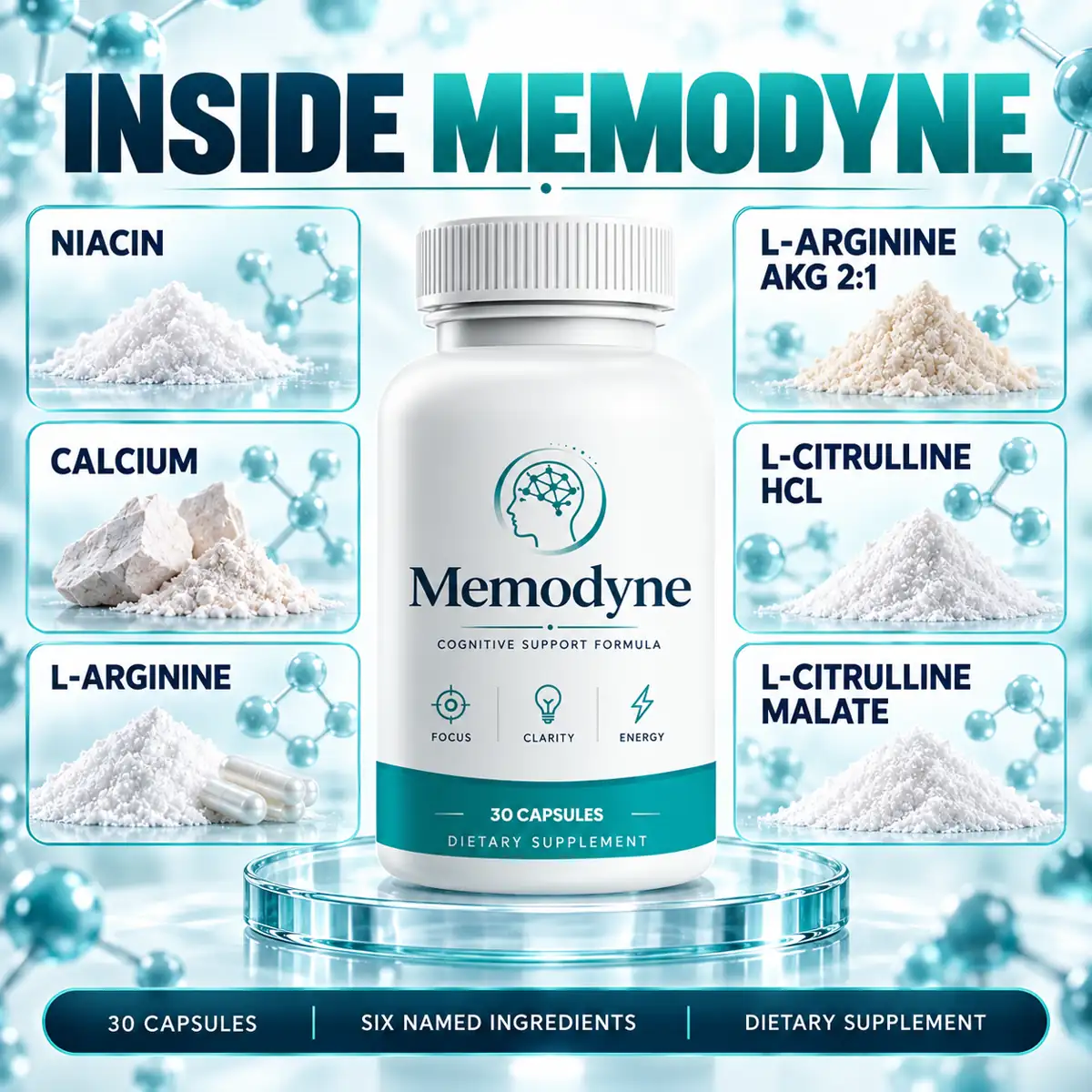
Neither gap changes what is in the capsule: calcium at 18 mg and beta-alanine at 40 mg are the two smallest rows on the panel. But it is the reason this website follows the panel and nothing else. The panel is the label; a sales page and an illustration, this website’s included, are descriptions of it, and where they differ, the label wins.
The arithmetic the panel makes possible
Here is what a panel gives a reader that a list of names cannot. Every one of those seven ingredients has a published literature, and every one of those literatures reports an amount. Set the two columns beside each other and the shape of the product appears.
| On the panel | Per capsule | What a study of it used | The capsule as a share |
|---|---|---|---|
L-Arginine (base) | 200 mg | A twentieth | |
L-Arginine AKG 2:1 | 200 mg | A sixtieth | |
L-Citrulline HCl and Malate | 200 mg together | A fifteenth to a thirtieth | |
Beta Alanine | 40 mg | A hundredth or less | |
Niacin | 7.5 mg NE | About a fifth of the ceiling, 47% of the DV | |
Calcium | 18 mg | Under 2 per cent |
The third column is what a published trial or reference table used for a single ingredient. The fourth is arithmetic on the panel, not a measurement of anything.
Read that table and the honest summary of this label writes itself. Five of the seven rows come from research measured in grams, and a once-daily capsule carries them in milligrams: a tenth of the arginine the blood-pressure curve needs, a fifteenth to a thirtieth of the citrulline in the pharmacokinetic study, a hundredth of the beta-alanine in the sports literature. The one row that reaches a studied scale is niacin, at nearly half its Daily Value, and it is not what the marketing leads with.
What the numbers mean for a specific reader
The general argument is easy to shrug off. The specific ones are where a panel earns its place, and three readers show it best.
The reader who already takes a multivitamin
A multivitamin prints an amount for niacin, and usually for calcium. So does this panel: 7.5 mg NE and 18 mg. Add them. The number to watch is niacin, because the 35 mg upper limit applies to the total from supplements, and two products at around half the Daily Value each are still comfortably under it.
The reader who has been told to watch their calcium
The Women’s Health Initiative gave 36,282 women 1,000 mg a day of calcium carbonate with vitamin D and recorded a 17 per cent higher rate of kidney stones, so calcium intake is worth tracking. This capsule’s 18 mg barely registers against a total counted in hundreds. The tablets and the diet are what to count.
The reader asking a prescriber
A prescriber handed seven amounts has a much easier question than one handed a list of names. The nitric-oxide rows are the ones worth pointing at, because nitrates, blood-pressure medicines and PDE5 inhibitors act on the same pathway; 400 mg of arginine and 200 mg of citrulline is well below the gram amounts that moved blood pressure in trials, and the prescriber can judge that for themselves.
Memodyne is sold with a full panel
One capsule a day, 30 to a bottle, and an amount printed for all seven ingredients. This desk prints what the label prints, and a 60-day window is the part of the offer it can guarantee.
Two, three and six-bottle packs · 60-day money-back window
Order Memodyne From This DeskBatch MEM-26/ME-4386 · a single capsule each morning · dispatched inside the United States
How to buy sensibly with the panel in hand
None of the arithmetic above amounts to never buy it. It amounts to buying with the right expectations, which changes how a sensible person goes about it.
- Buy the smallest pack first. The seller starts at two bottles, which is two months, and the window covers the whole of it.
- Treat every number you read anywhere as belonging either to the panel or to a study, and never let the second masquerade as the first.
- Check the panel on the bottle when it arrives against the table above. If it differs, the bottle is the authority, and this desk would like to hear about it: contact the editors.
- Expect a small effect if any. Amounts a tenth to a hundredth of the studied ones are not the amounts that produced the results in the papers.
- Use the window. 60 days from purchase is the one part of this offer with a number attached that somebody has guaranteed.
This label tells you exactly how much of each ingredient is in the bottle, and on a formula whose research is measured in grams, the answer in milligrams is the whole story.
What a label is required to carry, and this one does
It is worth separating two different things: what a bottle on a shelf in the United States must print, and what a sales page or an illustration happens to include. They are not the same, and the confusion between them is where most arguments about this subject go wrong.
A dietary supplement sold at retail carries a Supplement Facts panel by requirement: a serving size, the ingredients, amounts per serving, and percent Daily Values where reference values exist. It also carries a statement of identity, a net quantity, directions, the name and place of business of the manufacturer or distributor, and the disclaimer that accompanies any structure and function claim.
The Memodyne wrap has all of it: the panel, the directions line, a storage line, a caution line, a distributor block, the net quantity of 30 capsules on the front and the FDA disclaimer beside the panel. An ingredient illustration, by contrast, is a picture of powders, and the one on this website shows six of them.
- The bottle you receive is the regulated surface. Read it.
- An ingredient illustration is not a label, however much it looks like one, and that includes the one on this website.
- A website is further away still. Everything on this one is a description of a label, which is why the label outranks it.
- So the useful instruction is short: turn the bottle round when it arrives.
How this website handles it
Every page here prints the panel as the panel reads, and every other figure on this site belongs to a published trial of a single ingredient, is labelled as such, and links to the record. The two are never mixed.
The ingredients page takes the seven rows one at a time, the mechanism page explains what the formula is pointed at, and the choosing guide applies the same test to any product on the shelf.
- Schwedhelm E, Maas R, Freese R, et al. Pharmacokinetic and pharmacodynamic properties of oral L-citrulline and L-arginine: impact on nitric oxide metabolism. Br J Clin Pharmacol. 2008;65(1):51-9. PMID 17662090. https://pubmed.ncbi.nlm.nih.gov/17662090/
- Shiraseb F, Asbaghi O, Bagheri R, Wong A, Figueroa A, Mirzaei K. Effect of l-Arginine Supplementation on Blood Pressure in Adults: A Systematic Review and Dose-Response Meta-analysis of Randomized Clinical Trials. Adv Nutr. 2022;13(4):1226-1242. PMID 34967840. https://pubmed.ncbi.nlm.nih.gov/34967840/
- Campbell B, Roberts M, Kerksick C, et al. Pharmacokinetics, safety, and effects on exercise performance of L-arginine alpha-ketoglutarate in trained adult men. Nutrition. 2006;22(9):872-81. PMID 16928472. https://pubmed.ncbi.nlm.nih.gov/16928472/
- Trexler ET, Smith-Ryan AE, Stout JR, et al. International society of sports nutrition position stand: Beta-Alanine. J Int Soc Sports Nutr. 2015;12:30. PMID 26175657. https://pubmed.ncbi.nlm.nih.gov/26175657/
- Minto C, Vecchio MG, Lamprecht M, Gregori D. Definition of a tolerable upper intake level of niacin: a systematic review and meta-analysis of the dose-dependent effects of nicotinamide and nicotinic acid supplementation. Nutr Rev. 2017;75(6):471-490. PMID 28541582. https://pubmed.ncbi.nlm.nih.gov/28541582/
- Jackson RD, LaCroix AZ, Gass M, et al. Calcium plus vitamin D supplementation and the risk of fractures. N Engl J Med. 2006;354(7):669-83. PMID 16481635. https://pubmed.ncbi.nlm.nih.gov/16481635/
- Memory, Forgetfulness, and Aging: What's Normal and What's Not? National Institute on Aging, National Institutes of Health. https://www.nia.nih.gov/health/memory-loss-and-forgetfulness/memory-forgetfulness-and-aging-whats-normal-and-whats-not